· Business
Italy's concrete digital layer: forgotten records and real infrastructure
A country that feels behind, yet built PEC, e-invoicing, SPID, and AGID systems used every day. On visible digital hype versus long-term value.
- Italy
- digitale
- agenvio
- Entrepreneurship
- Artificial intelligence
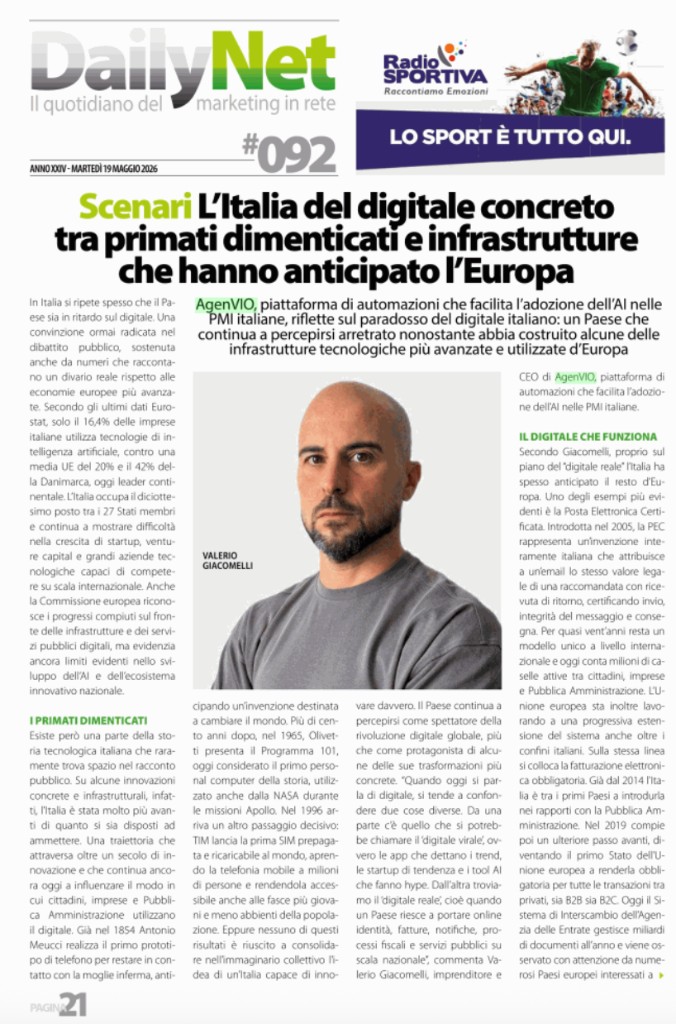
Thanks to DailyNet for the coverage and for mentioning AgenVIO.
The piece in the 19 May 2026 issue (no. 092) highlights a paradox I hear often: Italy still sees itself as digitally behind, while it has built some of the most advanced and concrete infrastructures in Europe.
That is not blind optimism. It is a distinction worth keeping in mind when we talk about the future, AI, and SME competitiveness.
The lag everyone quotes
Eurostat figures are well known: roughly 16.4% of Italian firms use artificial intelligence, versus an EU average around 20%. The gap is real and should not be dismissed.
But stopping there tells only half the story. It means measuring the country with the yardstick of visible digital: hyped startups, viral apps, buzzwords, trends that last a season.
The digital layer that actually changes daily work is often less spectacular. And Italy, in some domains, built it earlier than many peers.
Records nobody talks about
The DailyNet article recalls examples that rarely make it into conference keynotes, yet belong to our technological history.
Antonio Meucci and the telephone prototype in 1854. Olivetti's Programma 101 in 1965, the world's first personal computer, also used by NASA. The prepaid SIM, launched by TIM in 1996, now a global standard.
They are not folklore. They remind us that Italian innovation did not start yesterday and is not only storytelling.
Digital that works every day
Then there is the digital millions of citizens and businesses use without thinking about it.
PEC (certified email), since 2005, with legal weight comparable to registered mail. E-invoicing, mandatory for public administration from 2014 and between businesses from 2019, with Italy among European pioneers. SPID, electronic ID, AGID systems, and the broader public-sector digital ecosystem.
These are not trends. They are infrastructures. They change how we work, communicate, run a business, meet obligations, and interact with the state.
When they work, they do not make headlines. When they fail, they do. And we should demand that they work better. But denying that they exist at real scale is another kind of distortion.
Visible digital vs digital that creates value
The problem, perhaps, is that we too often confuse the two.
On one side, visible digital: virality, narrative, press releases, slides with new words.
On the other, digital that drives efficiency and long-term transformation: identity, invoices, public services, repeatable processes, compliance, data moving between systems without friction.
I believe Italy's digital future will depend less on telling itself it is late, and more on making the most of what it already builds well: concrete, reliable technology that creates real value.
That is the right ground for talking about AI in SMEs. Not as fashion, but as an extension of processes that already exist.
AgenVIO and real operations
AgenVIO was built in that direction: to bring automation and applied AI into operational workflows, not onto a stage.
It follows the same thread as the DailyNet piece and our work at Syncronika: fewer declarations, more systems that hold up when you leave the demo.
The challenge is not to prove Italy can innovate. It already has, many times. The challenge is to connect the infrastructures we have with everyday adoption in companies, without waiting for someone else to set the pace.
Closing
A country that still feels behind, yet has created some of the most advanced and concrete digital infrastructures in Europe.
The next step is not to copy whoever runs fastest on social media. It is to use better what we have already deployed, and build on top with the same seriousness.
Thanks again to DailyNet for putting it in print.
Clipping from DailyNet
Below: 19 May 2026 page (issue no. 092), Italian article on Italy's digital scenarios, infrastructure, and AgenVIO.
Note on the image: the scan is the Italian-language print page. Headline, body, and layout are in Italian; this English post is a companion note, not a full translation of the newspaper spread.