
· Technology
Why AI agents thrive in coding and struggle everywhere else
Almost half of today's AI agents live in software development. The reason is not the model, it is the feedback loop: immediate in code, slow and ambiguous in business processes.
- Artificial intelligence
- Syncronika
- Strategy
- Product
Today almost half of the AI agents in use are working in software development.
That is a useful number, but it is not the interesting one.
The interesting part is everything that is missing: customer service, finance, operations, logistics, manufacturing, healthcare. Huge areas that still account for a small share of overall usage.
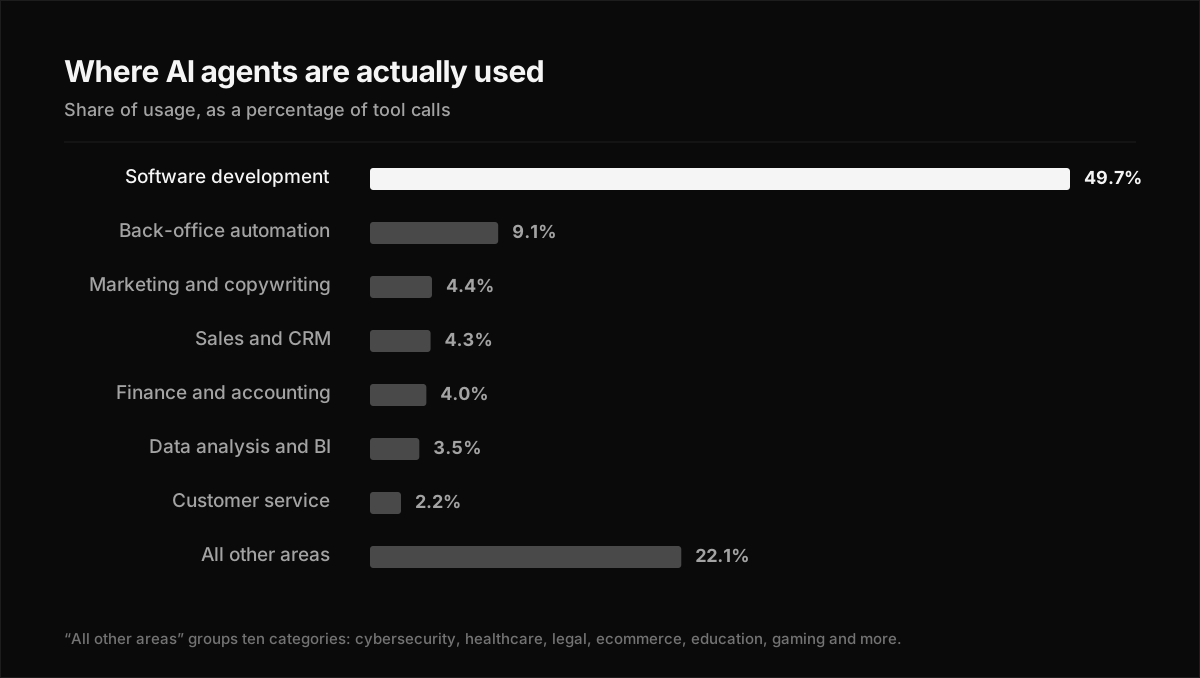
Looking at the breakdown by area, the gap is striking: below software development there is no close second. The runner-up stays under ten percent, and everything else splits crumbs.
The hidden advantage of code
In my view the reason is simple, and it has nothing to do with how smart the models are.
In coding, the agent has a closed and immediate feedback loop. The test passes or it does not. The build compiles or it does not. The linter complains or stays silent.
The agent knows within seconds whether it made a mistake, and it can correct itself.
That is a rare environment: the judgment on a decision arrives instantly, it is binary, and it is produced by the system itself without anyone having to stop and write it down.
In the real world the signal arrives late
Outside code, everything changes. The feedback loop is slow, ambiguous, almost never binary, and it usually needs a person to validate it.
An agent that decides a warehouse reorder finds out whether it was the right call weeks later, when that material is actually needed or sits on a shelf.
An agent that routes a support ticket finds out when the customer complains again, or when they stop complaining and nobody knows why.
An agent that schedules maintenance finds out when the machine breaks down anyway, or when it does not and no one can say whether that was thanks to the agent.
In all these cases the judgment exists, but it is scattered across the process. And almost never does anyone hand it back to the system that made the decision.
It is not a model problem
This is the part I think is underestimated.
It is not a model capability problem. It is an integration problem: ERPs, CRMs, machines, sensors, APIs, and internal procedures were not designed to return an immediate verdict on a decision.
They were designed to record facts, not to evaluate choices.
An ERP can tell you the order was issued. It cannot tell you it was the wrong order. A CRM can tell you the ticket was closed. It cannot tell you it was closed badly and reopened three days later under a different title.
Until that signal exists, an agent stays an executor nobody corrects. And an executor nobody corrects eventually gets removed from the process.
Where I see the next wave
In the projects we run at Syncronika the critical point is almost never the choice of model.
It is far more concrete: where do we get the signal that tells the agent whether it is doing well or badly.
Sometimes it is data that already exists but is never read. Sometimes it has to be built, by adding a confirmation step, a downstream measure, an event nobody was recording. Sometimes it means accepting that judgment stays human, and designing the flow so that the correction travels back instead of getting lost.
It is unglamorous work. But it is what separates a pilot that looks good in a demo from an agent that is still running six months later.
With AgenVIO we are building the platform that makes this monitoring possible: orchestrating processes across people, software, and devices, and above all keeping track of what happens after a decision.
Not to add dashboards. To close the loop.
Closing
Agents took over coding because coding already had the feedback loop built in.
In every other sector that loop has to be created, and it is a matter of integration, process, and data, not prompts.
Whoever does it first in their own domain does not just get more reliable agents. They get an operational layer that improves while it works, instead of staying frozen on the day it was switched on.