
· Business
From pyramid to diamond: how AI reshapes companies
After a Neil Patel interview: a thinner operational base, more strategic and creative roles. What remains is work for people who know how to orchestrate tools and decisions.
- Artificial intelligence
- Strategy
- Work
- Entrepreneurship
- Team
A few days ago I watched a Neil Patel interview on YouTube, and one idea stuck with me more than anything else.
The idea that companies are changing shape.
For decades we’ve seen a pyramid: the classic picture of the CEO at the top, managers in the middle, and a huge base of people doing the actual operational work, sometimes repetitive, often administrative.
A model we treated as a given, almost like a law of nature.
According to Patel, that shape no longer reflects today’s world of work. AI is fundamentally changing how companies run internally.
This isn’t a theory, it’s something we’re already seeing, and quite fast.
Fewer repetitive roles, fewer people dedicated to tasks that can be automated, more roles that are thoughtful, strategic, creative, experience-based, and oriented toward decisions instead of mechanical tasks.
Companies that are, in essence, leaner.
So the pyramid is turning into a diamond: as the base narrows, the middle can widen, and the real difference is no longer headcount but the quality of skills.
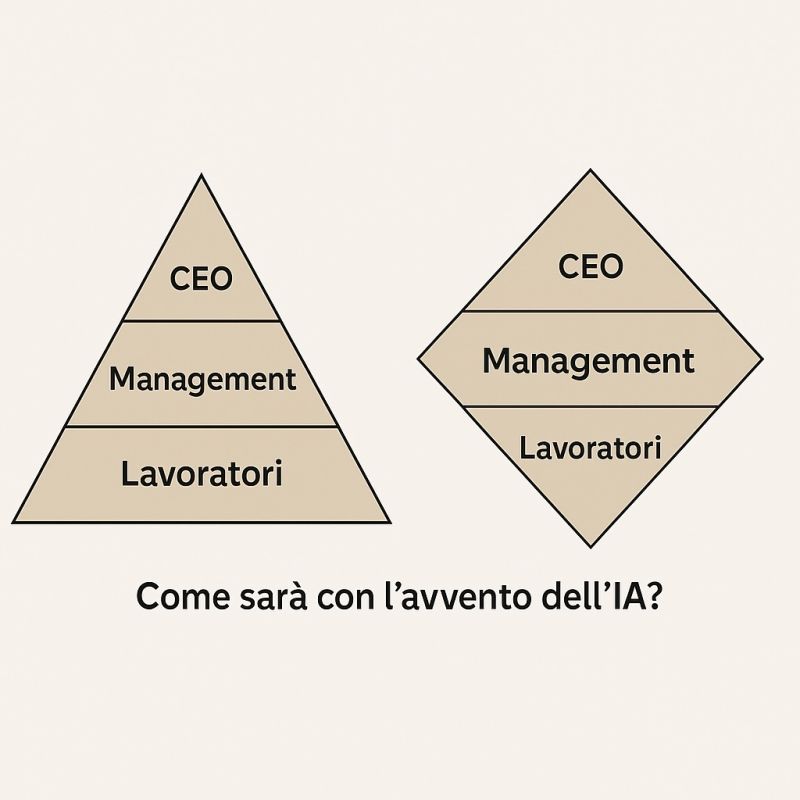
That fascinates me, because it means value is less about doing a lot and more about doing it well and in an optimized way, knowing how to use tools, orchestrate them, and connect the dots.
It means AI doesn’t erase all human work, it erases a certain idea of human work.
And it makes room for something far more interesting: people who lead, design, decide, imagine… who coordinate agents.
When I look at the future of work through this lens, I see a clear transition. And inevitably, many roles will disappear, especially for people who believe this shift doesn’t apply to them.
It’s a strong push to stay current, to learn, but above all to listen to the signals and sharpen skills in areas where AI probably can’t replace us, or at least not quickly.
Either way, I’m curious to see what shape companies will take in the coming years and how professions will evolve.
What a time to be alive! 😅
What I already see today is that people who know how to make tools work with their mind matter far more than people who insist on doing the job the way it’s always been done.