
· Thoughts
Young people are not leaving the internet. They are leaving the feed
Private conversations, long-form, vertical communities, talking to an AI: we are not less digital, we are more intentional. Attention is not disappearing. It is splitting.
- Strategy
- Values
- Vision
- Productivity
Young people, Gen Z in particular, are not leaving the internet.
They are leaving the feed.
Private conversations are growing, along with long-form content, vertical communities, and direct dialogue with an AI. We are not becoming less digital. We are becoming more intentional.
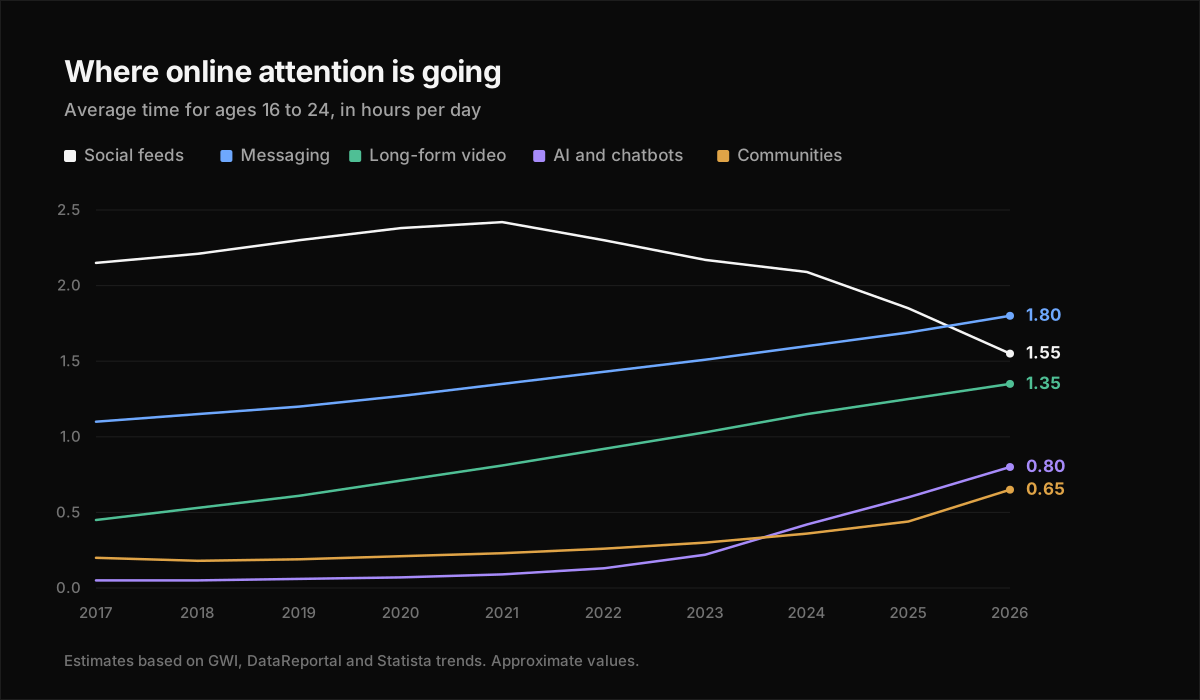
Time spent on public feeds is falling, while messaging, long-form video, communities, and AI tools keep rising. Attention is not shrinking. It is changing shape.
And that difference is huge.
Passive consumption and active acts
Scrolling a feed is passive consumption. You wait for something to hit you.
Looking for an answer, opening a topic on YouTube, joining a community, asking an AI agent a question: those are active acts. You decide where to go, and why.
For more than ten years the strategy was to intercept people while they scrolled: publish a lot, chase the algorithm, buy attention.
That strategy is deflating. Attention you buy on a passive feed is worth less and less. The person scrolling is not looking for you. They were just scrolling.
The tension of keeping writing
There is a tension here that concerns me directly.
I write on LinkedIn almost every day, and at the same time I argue that the feed is losing relevance. That is not a contradiction.
LinkedIn still holds, at least for now, because the people who write there have something at stake. It is not only passive entertainment. It is reputation. It is building a point of view over time. People who read here are usually looking for something, not just scrolling.
I would not assume it lasts forever. This feed will empty out in part as well.
Anyone who builds presence only on algorithmic distribution, with nothing underneath (owned data, community, direct relationships) will be exposed the moment the algorithm changes the rules.
Short and long do not compete for the same thing
There is a deeper reason behind all of this, and it has to do with what we are actually looking for.
Short-form and long-form do not compete for the same thing.
Short-form is optimized to keep you there, not to leave you with something. It is too short to do that.
Long-form competes for understanding.
What is happening is that people are starting to separate those two needs, instead of letting the feed blur them together.
Infinite short-form scrolling leaves the same feeling every time: a hit of dopamine in the moment, and nothing in your hands half an hour later. It is consumption that forgets itself. And a lot of time wasted.
Long-form, when it is done well, costs more attention. But it pays the time back, instead of draining it.
Closing
Attention is not disappearing. It is splitting.
On one side, passive entertainment, which will stay enormous and increasingly empty.
On the other, intentional understanding, which chooses where to go and what is worth the time.